
Nukleotidy, known in English as nucleotides, are fundamental molecules that form the basis of life on Earth. They are the essential building blocks of DNA and RNA, the molecules responsible for storing and transmitting genetic information in all living organisms. Without nukleotidy, life as we know it would not exist.
This article explores the structure, types, functions, and biological importance of nukleotidy, as well as their role in modern science and medicine.
What Are Nukleotidy?
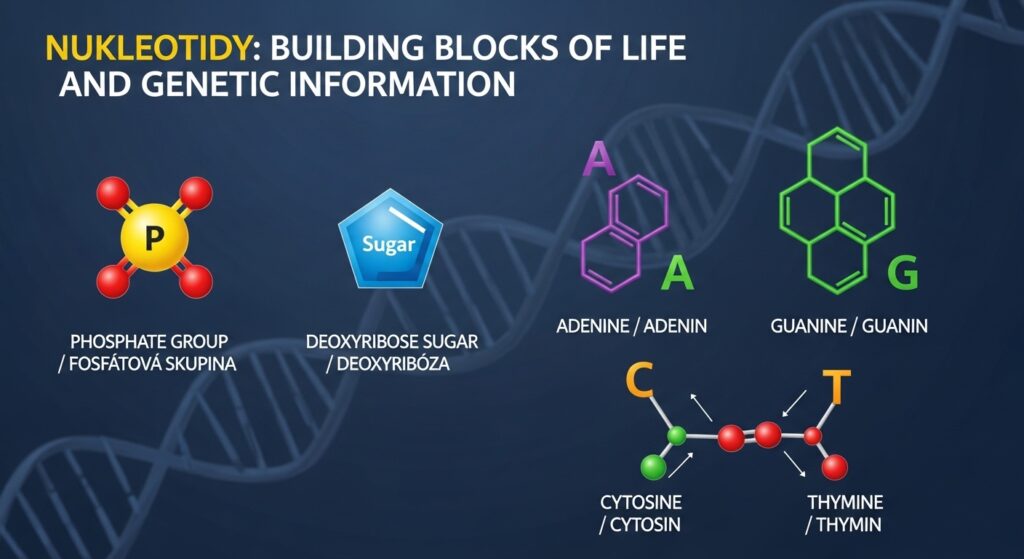
Nukleotidy are organic molecules composed of three main components:
-
A nitrogenous base
-
A five-carbon sugar
-
One or more phosphate groups
These three parts combine to form a complete nucleotide. When many nukleotidy link together, they create long chains known as nucleic acids — DNA and RNA.
Structure of Nukleotidy
Each nucleotide has a specific structure that determines its function. The three components work together in a precise arrangement:
Nitrogenous Base
There are two categories of nitrogenous bases:
-
Purines: adenine (A) and guanine (G)
-
Pyrimidines: cytosine (C), thymine (T), and uracil (U)
In DNA, the bases are adenine, guanine, cytosine, and thymine. In RNA, uracil replaces thymine.
Sugar Component
The sugar in DNA is deoxyribose, while RNA contains ribose. The difference between these sugars is small but significant, affecting the stability and function of the molecule.
Phosphate Group
The phosphate group connects nucleotides together, forming the backbone of DNA and RNA strands. This backbone provides structural stability and allows genetic information to be stored efficiently.
Nukleotidy in DNA and RNA
Nukleotidy join together through chemical bonds to form long chains. In DNA, two chains twist around each other to form the famous double helix structure, discovered by James Watson and Francis Crick in 1953.
The order of nucleotides in DNA determines genetic information. This sequence acts as a biological code that instructs cells how to build proteins, regulate functions, and reproduce.
RNA, on the other hand, plays a key role in translating genetic information into proteins. It acts as a messenger and functional molecule in protein synthesis.
Functions of Nukleotidy
Beyond forming DNA and RNA, nukleotidy serve several other critical functions in cells.
Energy Transfer
One of the most important nucleotides is adenosine triphosphate (ATP). ATP acts as the primary energy currency of the cell. It stores and transfers energy needed for cellular processes such as muscle contraction, nerve signaling, and chemical synthesis.
Cellular Signaling
Certain nucleotides are involved in signaling pathways. For example, cyclic AMP (cAMP) acts as a messenger molecule that helps regulate various biological responses.
Enzyme Regulation
Some nucleotides function as cofactors that assist enzymes in carrying out chemical reactions. These molecules are essential for metabolism and overall cellular function.
Biological Importance
Nukleotidy are vital for:
-
Genetic inheritance
-
Cell division
-
Protein synthesis
-
Energy metabolism
-
Cellular communication
During cell division, DNA must replicate accurately. Specialized enzymes copy nucleotide sequences to ensure genetic continuity. Errors in this process can lead to mutations, which may cause diseases or contribute to evolution.
Nukleotidy and Modern Medicine
Advances in genetics and molecular biology have expanded our understanding of nucleotides. Modern medicine relies heavily on this knowledge.
Genetic Testing
By analyzing nucleotide sequences, scientists can identify genetic disorders, inherited traits, and disease risks. DNA sequencing technologies have revolutionized diagnostics and personalized medicine.
Vaccines and mRNA Technology
Messenger RNA (mRNA) vaccines, developed during the COVID-19 pandemic, rely on nucleotide-based technology. These vaccines use synthetic RNA sequences to instruct cells to produce specific proteins, triggering an immune response.
Cancer Research
Mutations in nucleotide sequences can lead to uncontrolled cell growth. Understanding these mutations allows researchers to develop targeted therapies for various types of cancer.
Nukleotidy in Evolution
Genetic variation arises from changes in nucleotide sequences. Over time, these changes accumulate and drive evolution. Natural selection acts on variations that provide advantages for survival and reproduction.
By studying nucleotide differences among species, scientists can trace evolutionary relationships and better understand the history of life on Earth.
Environmental and Biotechnological Applications
Nucleotide research also plays a role in biotechnology and environmental science. Genetic engineering techniques allow scientists to modify organisms for agriculture, medicine, and industrial use.
For example:
-
Crops can be engineered for higher resistance to pests.
-
Bacteria can be modified to produce insulin.
-
DNA analysis helps monitor biodiversity and environmental changes.
These applications highlight the broad impact of nucleotide science beyond basic biology.
Future Perspectives
The study of nukleotidy continues to expand. Emerging technologies such as CRISPR gene editing enable precise modification of nucleotide sequences. This has the potential to treat genetic diseases, improve agricultural productivity, and address global health challenges.
As research advances, ethical considerations become increasingly important. Responsible use of genetic technology is essential to ensure benefits while minimizing risks.
Conclusion
Nukleotidy are the fundamental building blocks of life. From forming DNA and RNA to enabling energy transfer and cellular communication, they play a central role in every living organism.
Their importance extends far beyond basic biology. Modern medicine, biotechnology, and evolutionary research all rely on understanding nucleotide structure and function. As science continues to evolve, the study of nukleotidy will remain at the forefront of discoveries shaping the future of health, technology, and life itself.